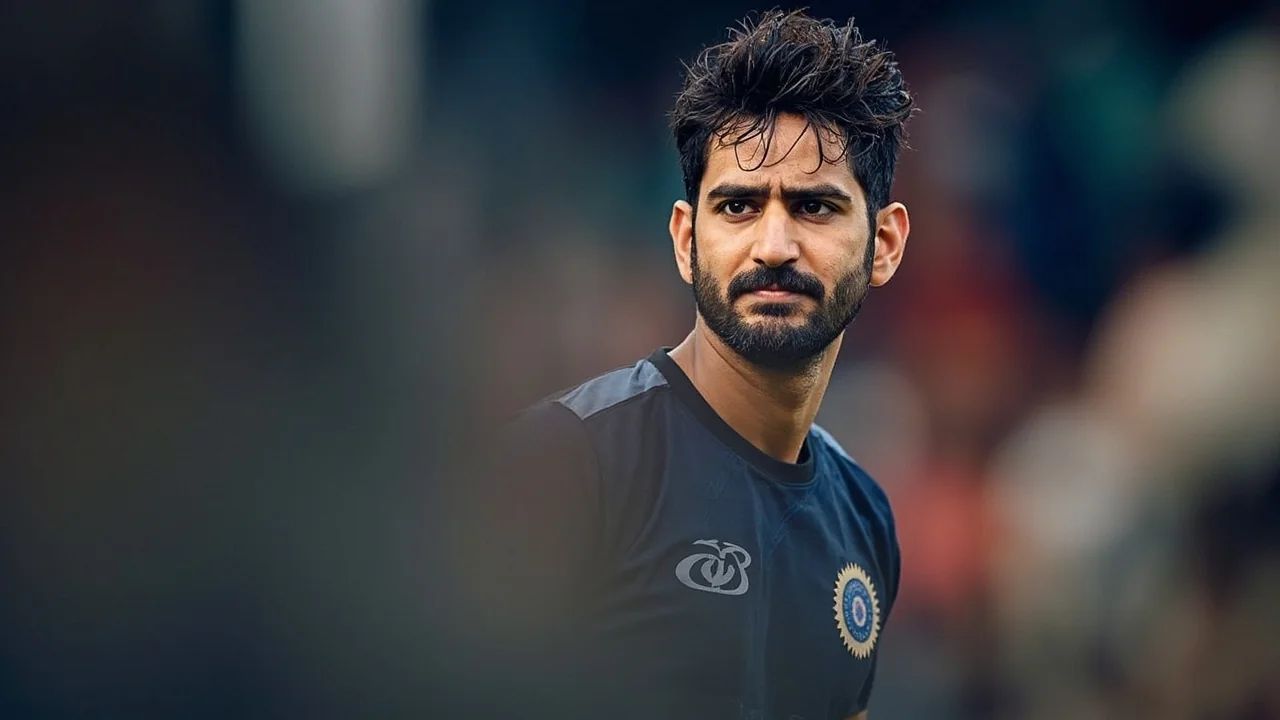
Vaibhav Sooryavanshi walked off the Harare Sports Club outfield on Tuesday afternoon with 81 runs off 49 balls at the back of his bat, the innings that closed India's 1-0 dead-rubber win over Zimbabwe and ended a senior international debut tour that began with three single-figure-or-near-low scores against Jofra Archer and the England quicks in Manchester. The line of six T20I scores — 14 at Old Trafford, 13 at Edgbaston, 15 at Lord's, 50 in the first Zimbabwe T20I, 20 in the second and an unbeaten 81 in the third — is the first senior-international record the 14-year-old Rajasthan Royals opener owns, and it is the evidence base that Ajinkya Rahane, speaking to reporters in Harare hours after the third T20I, was warning against over-reading.
"I don't want to say anything and put pressure on that young kid," Rahane said at the team hotel on Tuesday. "Because people are already talking a lot about him. It's just two IPL seasons. What I've realised is that IPL and international cricket are completely different. The pressure when you represent your country is enormous. Chasing 70 runs in IPL in 4, 5 overs easy. Chasing the same amount of runs in international cricket is different. So, let him just play his game, let him just grow." The senior batter, who is in Zimbabwe as a mentor for the India squad and not as a player, was asked about Sooryavanshi's tour, not about the Rajasthan Royals teenager specifically — and the answer he gave was, in effect, a calibration of the senior-international conversation around the youngest player India has named to a 15-member squad.
The six-inning line that the selectors now own
The headline statistic that the selectors carry out of the tour is the line itself. Sooryavanshi's six innings sit in three distinct phases: a Manchester trial against Archer, Mark Wood and the England short-ball plan; an Edgbaston–Lord's stretch where the same plan kept recurring and a third dismissal to the short ball brought three single-figure-or-near-low scores; and a three-inning move to slower surfaces in Harare in which the batting arc reset. Against Archer specifically, Sooryavanshi was dismissed in two of his three England innings; against pace in general, his three England innings averaged 14 at a strike rate near 87. Against Zimbabwe's spin-heavy attack in Harare, he averaged 75.5 with a strike rate of 162.4 — a split large enough to be a usable diagnostic for the chairmen of selectors when they sit down to weigh the white-ball case against the longer-format one.
The 81 in the third T20I is the innings that resets the tour arithmetic, and it does so for a specific reason. India needed 158 in a dead rubber, a target that left the openers with risk to manage in the powerplay and tempo to control in the middle overs. Sooryavanshi opened with Abhishek Sharma, took 18 off the first two overs, slowed against the spin of Sikandar Raza and Brandon Mavuta through overs 7 to 14, and then accelerated in the closing four overs with seven sixes — four off Raza's off-spin in the 17th and 18th overs and three off the pace of Richard Ngarava and Blessing Muzarabani. The architecture of the innings is, in other words, the answer to Rahane's "chasing 70 in international cricket is different" point: a teenager who can recalibrate his own tempo against an attack that asks different questions in overs 7 to 14 is closer to senior-international cricket than a teenager who only knows how to swing at the powerplay.

Where the short ball fits in Sooryavanshi's game
The single most-cited weakness across the tour is Sooryavanshi's record against the short ball. In IPL 2026 the Rajasthan Royals batter hit short balls for six at a rate that, at one point during the season, had him on the verge of the fastest century in the tournament's history before he fell short of the milestone in the 17th over. In England that same shot, for the same bowler, kept bringing him undone. Archer dismissed him twice in the series, Wood once, and the third dismissal at Lord's came off a back-of-a-length ball from Sam Curran that climbed steeply past a pull shot. The pattern was visible enough that the England attack stopped bowling him anything else — three of his six dismissals on tour were to the short ball, and the third was the only one where he was not in the first ten balls of an innings.
That is not an unusual pattern for a teenager crossing from franchise cricket into senior international cricket. The IPL is a tournament played on flat home decks with team-mates groomed to find the teenager's batting arc, against attacks that bowl to plans the franchise scouting team has already mapped. Senior international cricket, especially in England in mid-summer, is bowled on a wider variety of surfaces, in conditions that range from green seamers to slow turners, with team-mates the teenager has met only in the week before the series. The short-ball plan that England used in Manchester is the same short-ball plan New Zealand used against Yashasvi Jaiswal on his 2024 debut tour, the same short-ball plan Pakistan used against Shubman Gill in 2023, and the same short-ball plan South Africa will use when Sooryavanshi's Test case comes up — because the short ball is the default plan against any young Indian batter whose reputation runs ahead of his first-class record. The right response, as Rahane's caution suggests, is to give the teenager senior white-ball cricket to absorb the plan, not to either fast-track him to red-ball cricket or pull him out of the side.
What the Orange Cap actually told the selectors
Sooryavanshi took the Orange Cap at the end of IPL 2026 with 776 runs at an average of 56.4 and a strike rate of 168.6, and finished the league stage at the centre of one of the more concentrated debates in recent IPL history. Sachin Tendulkar, speaking before the India squad for the Ireland-England T20Is was announced, said publicly that the teenager had the temperament for Test cricket and that the selectors should not be afraid to blood him in the longer formats. The chairman of selectors, Ajit Agarkar, told the BCCI's media partner at the squad announcement that the committee had "no other option" but to pick the teenager after the Orange Cap run. Both public positions contributed to the framing that turned Sooryavanshi's first senior-international tour into a referendum on whether 14 is too young for India selection, and Rahane's remarks on Tuesday are the first senior-international counter-framing from inside the dressing room.
The 776-run Orange Cap run is real evidence that the teenager can dominate an IPL attack — and it is the kind of evidence that did not exist in the last decade for a 14-year-old opener. It is also, on the available record, incomplete evidence for a Test call-up. The IPL is a tournament played across 14 home venues over a 10-week window, with a powerplay that rewards attacking batters, a middle phase that rewards players who can hit spin, and a death phase that rewards boundary clearers. The Test side plays on a wider variety of surfaces, in conditions where the first ten overs often require a different set of skills, and with team-mates the batter has not shared a dressing room with for long. Rahane's framing in Harare is that the two pieces of evidence should be treated as separate decisions with separate evidence bases, and that the right response to a six-inning debut tour is to give the white-ball case its next senior-international cycle and to defer the Test call until the red-ball evidence arrives.
How the IPL-to-Test pipeline has handled prodigies
Indian selectors have, by design, used the IPL as a showcase for young batters but kept the Test side as a separate decision with its own evidence base — and the historical pattern is the playbook Rahane was reading from on Tuesday. Sachin Tendulkar debuted in Tests at 16 and was not thrown into the senior ODI side until 18, after a full first-class track record with Mumbai. Yashasvi Jaiswal debuted in the IPL at 17, played three full seasons before his India senior T20I debut, and was not selected for India's senior Test side until 21, after a Ranji Trophy season in which he averaged 78 with the bat. Shubman Gill debuted in the IPL at 18 and was not selected for India's senior Test side until 22, with a domestic first-class record and a County Championship stint with Glamorgan as the bridge evidence. The pattern across the last decade has been that the selectors use the IPL to identify the candidate, the domestic circuit to test the technique, and the Test side as the eventual landing point on a separate evidence trail.
Sooryavanshi's path through the system is, on the available record, running ahead of that pattern. He was named to a 15-member India squad at 14, played his first T20I at Old Trafford within a year of his IPL debut, and is, by way of the Zimbabwe tour, the youngest opener to start a senior-international white-ball series for India. The debate over whether the white-ball path should translate to a Test call-up in the same calendar year is the context for Rahane's remarks, and the senior batter's point is that the historical pattern has worked because the selectors respected the gap between the white-ball and red-ball evidence bases. Reopening the gap would, in Rahane's framing, put the kind of pressure on a 14-year-old that no senior player wants to put on a teenager who has only just learned how to recalibrate his tempo against senior spin.

What the comment was, and what it was not
Rahane's intervention was not a swipe at Sooryavanshi, and the senior batter was careful to say so. The quote that ran in the report — "I don't want to say anything and put pressure on that young kid" — was as much a comment on the public conversation around the teenager as a comment on the teenager himself. The next sentences ("it's just two IPL seasons", "IPL and international cricket are completely different", "chasing the same amount of runs in international cricket is different") make clear that Rahane was pushing back against the framing that has, in the four weeks since the England tour, suggested the teenager should already be in the India Test squad. The closing instruction — "let him just play his game, let him just grow" — is, in other words, the same caution that selectors have historically applied to young Indian batters crossing from the IPL to the senior-international side.
What the comment was not is a critique of Sooryavanshi's technique. The 81 in the third Zimbabwe T20I is the kind of innings that gets a teenager out of a debut tour debate and into the next senior-international cycle, and Rahane — who has seen enough senior-international cricket to know how the conversation moves — was careful to leave the batting on the table. The senior-voice calibration is not about whether Sooryavanshi can bat; it is about whether the selectors should treat the next Test squad announcement as the right place to put that evidence to work. The implicit answer, on the available record, is that the next senior-international assignment is the right place — and the Ranji Trophy block that opens in October is the right bridge to whatever comes after that.
The Asia Cup squad and the calendar that follows
The immediate calendar decision that matters for Sooryavanshi is the Asia Cup T20I squad, expected in the second half of August. India are defending the title they won in 2025 under Suryakumar Yadav, and the squad is the first senior-international assignment since the Zimbabwe dead-rubber. On the available tour arithmetic — six innings, a tour average north of 30, a closing 49-ball 81 in a chase that required tempo management — Sooryavanshi is, on the form book, a near-certainty for the squad. The competition for the opener slot is the conversation the Asia Cup press conference will get, not the conversation this column is making; the senior-international question Rahane addressed was a separate one about the longer-format decision the selectors would face later in the year.
The longer-format decision runs through October. Rajasthan's Ranji Trophy season opens in the second week of October, which means Sooryavanshi will, for the first time in his senior career, be available for selection in Rajasthan's senior red-ball squad. Ranji cricket is the bridge the senior India selectors have, historically, used to blood young batters into the Test side — Jaiswal's Ranji average before his Test call was 78, Gill's Ranji record before his Test call included a double-hundred, and even the older pattern of Tendulkar at 16 was preceded by 14 first-class hundreds across two full domestic seasons. A strong Ranji season from Sooryavanshi would, on that historical pattern, be the cleanest evidence the selectors could ask for ahead of the West Indies home series in late October, and the West Indies series would, on the same pattern, be the next logical Test squad venue for the teenager. The path is not fast. It is, on the available record, the path that has worked.
Where the conversation lands from here
Rahane's remarks reset the senior-international conversation around Sooryavanshi in a useful way, and the reset is the conversation the selectors, the Rajasthan Royals coaching staff, and the India captain will work with through the Asia Cup cycle. The 81 in Harare is the batting evidence the teenager needed; the six-inning tour average is the senior-international evidence base; Rahane's quote is the senior-voice calibration that signals the Test call should not be rushed. The wider Indian cricket conversation has, in the four weeks since the England tour, swung between "should he be in the Test squad now" and "is the IPL-to-Test leap too steep for a 14-year-old," and the right response to that swing is to put the next senior-international assignment on the calendar and to use the Ranji Trophy as the bridge evidence.
For the wider Indian cricket conversation, the lesson Rahane's remarks offer is the lesson selectors have applied to young batters across the last decade — that the IPL is the showcase, the Ranji Trophy is the bridge, and the Test side is the landing point on a separate evidence trail. Sooryavanshi's path through the system is running ahead of the historical pattern, and the senior-voice calibration from Rahane is the dressing-room reminder that the historical pattern has worked because the selectors respected the gap. For the wider IPL Players dossier on the site, the player index tracks the form, role and selection context behind every name on the squad sheet — and the context for Sooryavanshi, on the available record, is the senior-international reset that the 81 in Harare and the quote that followed it has now earned: every senior India player, with career numbers, recent form and the role context behind the selection.